“Giftedness is not what you do or how hard you work. It is who you are. You think differently. You experience life intensely. You care about injustice. You seek meaning. You appreciate and strive for the exquisite. You are painfully sensitive. You are extremely complex. You cherish integrity. Your truth-telling has gotten you in trouble. Should 98% of the population find you odd, seek the company of those who love you just the way you are. You are not broken. You do not need to be fixed. You are utterly fascinating. Trust yourself!”

Linda Silverman~Gifted Development Center Denver


Showing posts with label Math Chat. Show all posts

Monday, 4 August 2014

Let's CHAT!


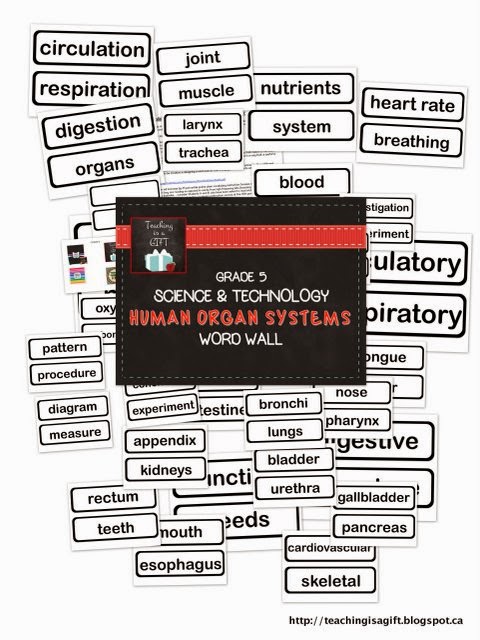
Teachingisagift Human Organ Systems Word Wall for Grade 5 Science

Teachingisagift Human Organ Systems Word Wall for Grade 5 Science

Students are expected to be able to use appropriate science and technology vocabulary and use a variety of forms (e.g., oral, written, graphic,multimedia) to communicate with different audiences and for a variety of purposes.  One way to get students reading and writing is the use of word walls.  According to the Ministry of Education for Ontario "A word wall is an ongoing, organized display of key words that provides visual reference for students throughout a unit of study or a term. These words are used continually by teachers and students during a variety of activities. Word walls serve multiple purposes.
Effective word walls: 
- support the teaching of key words and subject-specific
terminology. 
- promote independence in reading and writing by building vocabulary. 
- provide visual clues and reference for language learners
- help students remember connections between words and concepts. 
Building a word wall can be easily integrated into daily activities. Key words and/or terminologies that relate to the lesson or unit of study can be added gradually as they are introduced. A word wall should be organized in a way that is useful to students with additions reflecting the skills or concepts being taught. Often, word walls are organized alphabetically, with words printed on card stock, and 
taped or pinned to the wall/board. Teachers are encouraged to be creative is designing a word wall so that it engages the students and enhances their learning. "

Some possible variations: 
• Using different-coloured card stock helps to distinguish concepts/terms belonging to different units of study 
• A picture or photograph adds further clarification for visual learners or English language learners. 
• Words can be accompanied by their definitions. 
• The back of the word card can be used to display both verbal and visual word associations, graphics, definitions, and characteristics of the word. 
http://www.edu.gov.on.ca/eng/studentsuccess/thinkliteracy/files/thinklitwordwalls.pdf

I am pleased to announce that I am creating word walls for all of the Ontario Curriculum Science and Technology topics. My first one is finished and posted.  Just click on the image above to purchase it.  While you are visiting my store be sure to become a follower by clicking on the FOLLOW button.  Keep your eyes open for new grades and topics coming soon!


Another way to get students communicating in math and science is by encouraging "accountable talk" or as I like to call it Math/Science Chat.  Using Math/Science Chat speech bubble starters can get your hesitant students talking about what they are learning in math. Using communication in the classroom to represent, explain, justify, agree, and disagree affects the way students learn mathematics. Math/Science Chat engages students, encourages them to learn more, and allows for the exploration of ideas, strategies, procedures, facts, and more.Encouraging the development and exchange of ideas, Math/Science Chat helps to support a social learning environment for students, creating a community which fosters encouragement, respect, and the exchange of ideas.

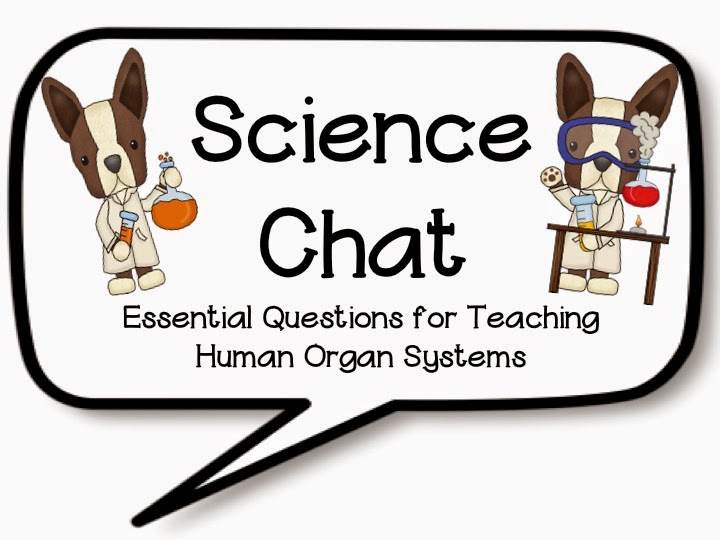
To accompany each word wall, I have created a Science Chat which contains the BIG IDEAS for the topic, as well as a series of essential/guiding questions.  You can use these in a variety of ways, including printing them out and creating a display or bulletin board, using them as part of your Interactive Science Notebook, or project them on your Smartboard.  

Teachingisagift Human Organ Systems Science Chat for Grade 5 Science

Teachingisagift Human Organ Systems Science Chat for Grade 5 Science

Teachingisagift Human Organ Systems Science Chat for Grade 5 Science

Math Chat is my BEST SELLER so I have decided to bundle it together with my NEW Science Chat.  You can get both great products for one amazing price!  Just click on any of the images below to learn more.
Teachingisagift Math and Science Chat Bundle

Teachingisagift Science ChatTeachingisagift Math Chat

Don't forget that the big sale starts today at TPT!  You can get up to 28% off all the products listed above!  Just click on the image below to visit my store and don't forget to use code BTS14 at checkout!


Sunday, 17 March 2013

Math Chat


Do you have a Math Chat learning community in your classroom?  


In your classroom, this means: 
• making both students and teacher responsible for asking questions; 
• providing a supportive environment whereby students can confidently express their understandings, and explain, defend, and justify their mathematical thinking to others in the class; 
• confirming that students are recognized as important sources of mathematical ideas by regarding their suggestions as valid and worthy of further exploration; 
• encouraging problem solving in a variety of ways with students collaborating in reasoning and explaining solutions; 
• requiring students to take responsibility for their own learning by asking questions in class, demonstrating their understanding of problems, and sharing their solutions with others.
( Math Talk Learning Community: Professional Learning Guide, MOE, http://bit.ly/10Wwdrf)


I do not use a traditional textbook in my classroom.  I don't find that it best meets the needs of my gifted students.  I  used one for one year, but both the students and myself were utterly frustrated and the students academic results were not what they should have been. I abandoned the text book and went with what I know best~ hands-on, minds-on instruction.  

If you have read my earlier posts you will know my students create a "Math Survival Guide" the first week of school.  They use this all year to learn the important mathematics vocabulary we are studying.  I believe that it is important to activate prior knowledge before starting a new unit, and this is one strategy that helps with that.  It gives the students and myself a chance to see what they already know, and find out what they still need to learn.  As the unit continues students revise and add information to their survival guides.  They use them frequently in daily work, and for studying and reviewing before quizzes and tests.

This year I also started using Interactive Math Notebooks.  We only started these part way through the year, but so far this approach has integrated well with how I structure math instruction in my classroom.   For example, I find using the Guides to Effective Instruction in Mathematics with my classes to be highly engaging.  The contents of these documents are organized by grade, and material related to a specific grade can be pulled out and used on its own.  The activities/investigations in these guides fit really well with the format and structure of an interactive math notebook.

I particularly like how the guides take into account the specific needs of junior learners.  The graphic below illustrates how important Math Chat is to the junior student.  Math Chat supports intellectual, physical, psychological  social, and moral and ethical development.


Structuring the Math Chat classroom, the teacher must take into account the social/emotional needs and development of the students.  One strategy that supports Math Chat is the creation of Anchor Charts.  "Anchor Charts are developed together with the class to make thinking permanent and visible. They allow the class to clarify thinking, make connections, and/or remember a specific skill, strategy, or concept. These skills will be used throughout the year while doing group work/ cooperative activities. The charts can be kept and reviewed periodically, as needed." 
(http://www.edu.gov.on.ca/eng/studentsuccess/lms/files/SocialSkills.pdf)

Before introducing Math Chat to my class, I made sure we reviewed each social skill listed below (Encouraging Others, Taking Turns, Active Listening and Summarizing, Including All Participants and Disagreeing in an Agreeable Way).


CLICK ON THE DOCUMENT ABOVE TO VIEW IN LARGER FORMAT
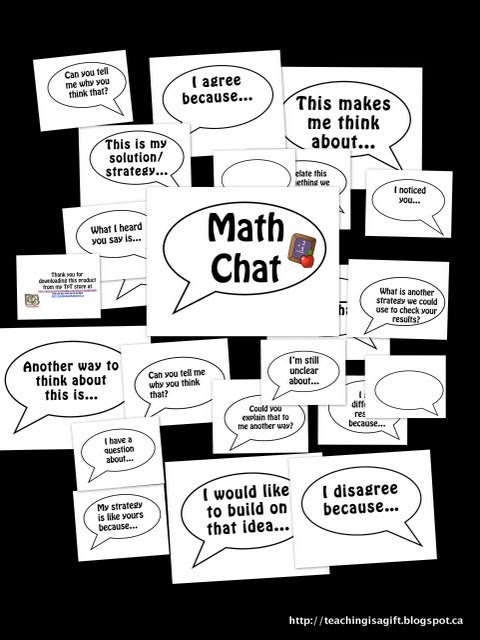
I did not want to keep reminding students of HOW to discuss math problems and math investigations while we working in groups, so I decided to create some speech bubbles and place a Math Chat sentence stem in each one.  I have found that the students refer to them often, and when they get off track, I can redirect them and point at them posted on the wall.

You can download a FREE preview by clicking on the image below.  


I hope you love your FREEBIE!  
If you decide you would like to purchase the entire set of Math Chat speech bubbles CLICK on the image below to get the entire set of over 20 bubbles!


If you are interested in standardized test preparation be sure to come back on Friday for the 
BIGGEST, MOST COMPREHENSIVE MATH FREEBIE yet!
Classroom Freebies Manic Monday

post signature