“Giftedness is not what you do or how hard you work. It is who you are. You think differently. You experience life intensely. You care about injustice. You seek meaning. You appreciate and strive for the exquisite. You are painfully sensitive. You are extremely complex. You cherish integrity. Your truth-telling has gotten you in trouble. Should 98% of the population find you odd, seek the company of those who love you just the way you are. You are not broken. You do not need to be fixed. You are utterly fascinating. Trust yourself!”

Linda Silverman~Gifted Development Center Denver


Showing posts with label Combined Grade Science. Show all posts

Sunday, 7 November 2021

ONTARIO SCIENCE AND TECHNOLOGY ASSESSMENT OF LEARNING TESTS


"The primary purpose of assessment and evaluation is to improve student learning. Information gathered through assessment helps teachers to determine students’ strengths and weaknesses in their achievement of the curriculum expectations in each subject in

each grade. This information also serves to guide teachers in adapting curriculum and instructional approaches to students’ needs and in assessing the overall effectiveness of programs and classroom practices." (The Ontario Curriculum Science and Technology, pg. 22)


The Ontario curriculum is designed in such a way that evaluation focuses on students’ achievement of the overall expectations, although all curriculum expectations must be accounted for in instruction and assessment. (See Growing Success: Assessment, Evaluation, and Reporting in Ontario Schools, p. 38.)


For as long as I have been creating resources for science and technology, teachers have been asking me how to assess what students have learned.  Having been an Ontario teacher for over 30 years, I have developed a repertoire of assessment and evaluation techniques based on my lived experiences with students. When they are working I am making observations, giving them oral feedback and checking that their written work is accurate and complete. 


As teachers we record our observations on checklists and use rubrics for major projects and notebooks. Each time I teach a new topic in science and technology, I use the student notebooks and their Let's Create! and Let's Inquire! tasks as part of my triangulation of data but I wanted to create an assessment piece that would help tie all of the parts of my assessment data together.


Enter my NEW editable assessment of learning tests!


These tests:

  • address both what students learn and how well they learn;
  • are based both on the categories of knowledge and skills and on the achievement level descriptions given in the achievement chart on pages 26–27
  • accommodate students with special education needs, consistent with the strategies outlined in their Individual Education Plan;
  • accommodate the needs of students who are learning the language of instruction;

These tests are aligned with all of the science and technology resources that are available in my Teachers Pay Teachers store and will give teachers, students and parents a way to share what students have learned during the unit of study.

Click on any of the images below to see the BUNDLES available in my store. All of the assessment of learning tests are also available individually and you can view the links to each within the bundle for that grade.


PICTURE OF GRADE 4 ONTARIO SCIENCE TESTS


PICTURE OF GRADE 5 ONTARIO SCIENCE TESTS


PICTURE OF GRADE 6 ONTARIO SCIENCE TESTS


Sunday, 31 July 2016

Combined Grade Science and Technology

Combined Grades Science and Technology Centres


It's almost back to school time and most teachers don't want to even begin to think about going back. I have been thinking. . . but not about going back, but about combined grades. There have been big changes in my school this year and most teachers will have a combined (or split) grade next year. Once upon a time, years ago in my teaching career, I was referred to as the "Queen of Combined Grades". I had taught many years in a combined grade setting and wrote some curriculum documents for the Ministry of Education about how to teach in a combined grade. When I worked as an instructional leader/coach, I gave a series of workshops about teaching combined grades, and I often went into to schools to help teachers plan for their combined grades.

One of the strategies I always suggested when I was giving workshops or working in classrooms was to teach using centres. When I was teaching in the classroom, I realized that I could have students working at centres for math and science which would allow me to go around and observe, discuss and assess. I would find materials that would work in bins or tubs (often from my board's science kits) and then set up the centres. The kids would be given periods to rotate through the centres and experience hands on, minds on science. The hard part was always finding activities and investigations that would work for both grades, both topics AND work in centres.  

After spending at least the past decade thinking "It would great if someone would just go ahead and make combined grade centres for science and technology!", I decided to create my own. Below you can see some of students working on a centre from my Forces Acting on Structures and Mechanisms unit.

Combined Grades Science and Technology Centres


I am the first to admit that you have to put some effort into collecting the materials and putting the centres together, but once you have it done, your students (and you) will reap the benefits. Students can work at developing the same skills, while each group is investigating the grade level curriculum topic for their grade. The centres I have created include 10 different centres for each grade. These include a variety of hands-on, minds-on investigations and activities geared towards engaging students in the junior division.

Grade 5 Let's Explore Centre Card

Grade 4 Let's Explore Centre Card


Combined Grades Science and Technology Centres

I suggest that you introduce centres to your students early in the year. I do not use ONLY centres to teach my program.  A variety of approaches keep students engaged and learning. I like to show videos and often use powerpoint presentations to introduce a unit. I have also had presentations by groups such as Scientists in School to kick off or wrap up a unit. I also introduce and teach vocabulary as an essential part of student success in communicating their learning. The use of a word wall in a classroom can be a highly effective teaching strategy to improve literacy skills. Word wall activities encourage active student participation. Gestures, such as pointing to key words during a lesson, offer visual reinforcement which can be very helpful for students.  

Combined Grades Science and Technology Illustrated Word Wall
I created word walls to go along with all of my science and technology centres.  I know my students are more likely to use the correct terminology if I introduce it to them at the beginning of the unit. You can have students create their own visual dictionaries in their science notebooks, or you could print out the word wall cards and have them glue into an interactive notebook. The choices for use are endless.  I also find these vocabulary cards to be very effective with ESL and ELL learners.


If you are looking to try out some combined grade science and technology centres this year just click on the image above. Each MEGA BUNDLE includes SCIENCE CENTRES for BOTH grades and ILLUSTRATED WORD WALLS for both grades as well. These bundles are ready for immediate use in your classroom!  

Picture of Combined Grade Science and Technology Bundles Ontario Science


Don't teach a COMBINED GRADE?  That's okay, all of my SCIENCE CENTRES and ILLUSTRATED WORD WALLS are available for individual grades as well.  

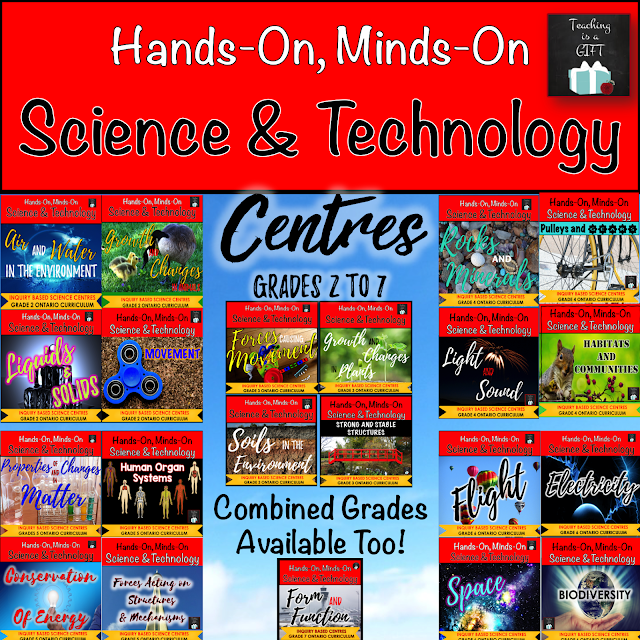
Picture of Hands-On, Minds-On Science and Technology Centres Ontario Science